
What is a Resource?
Resources are a way to expose data content — documents, files, database query results, or any structured information — to AI clients via the MCPresources/read method. Unlike tools (which execute actions), resources provide read-only content that the AI can reference.
Think of resources as:
- Documentation or knowledge base articles the AI should be aware of
- Real-time data from your database (e.g., product catalog, user list)
- Static configuration or reference content
- WordPress posts/pages exposed as MCP-readable content
Resource Properties
Resource URI
Every resource has a unique URI that serves as its identifier. Any URI scheme is valid:resources/read.
Data Source Types
static
The simplest type. Define the content directly in the editor — it never changes unless you update it:url
Content is fetched from an external URL each time the resource is read. The fetch happens server-side from WordPress, so it works behind firewalls:cache_ttl (optional, seconds) caches the remote response to avoid hitting the upstream URL on every read. Default is 0 (no cache).
wp_query
Query your own WordPress database and expose the results as a resource. Accepts any standard WP_Query argument:callback
Call a registered PHP function to generate content dynamically. The callback receives($resource, $params) and must return a string:
Resource Templates
Resource templates allow parameterized resources using URI templates (RFC 6570). Instead of a fixed URI pointing to one piece of content, a template defines a pattern where part of the URI is a variable the AI client fills in at read time.How Templates Work
Set the Template URI field to a pattern with{variable} placeholders:
resources/templates/list, it receives the template pattern. The client then substitutes concrete values and calls resources/read with the expanded URI:
Static URI vs Template URI
Template Example
A resource that serves any WordPress post by slug:resources/read with wp://posts/my-post-slug and receives that post’s content.
Creating a Resource
1
Open the Resources Tab
Inside a server, click the Resources tab.
2
Click Add Resource
Click Add Resource to open the resource editor.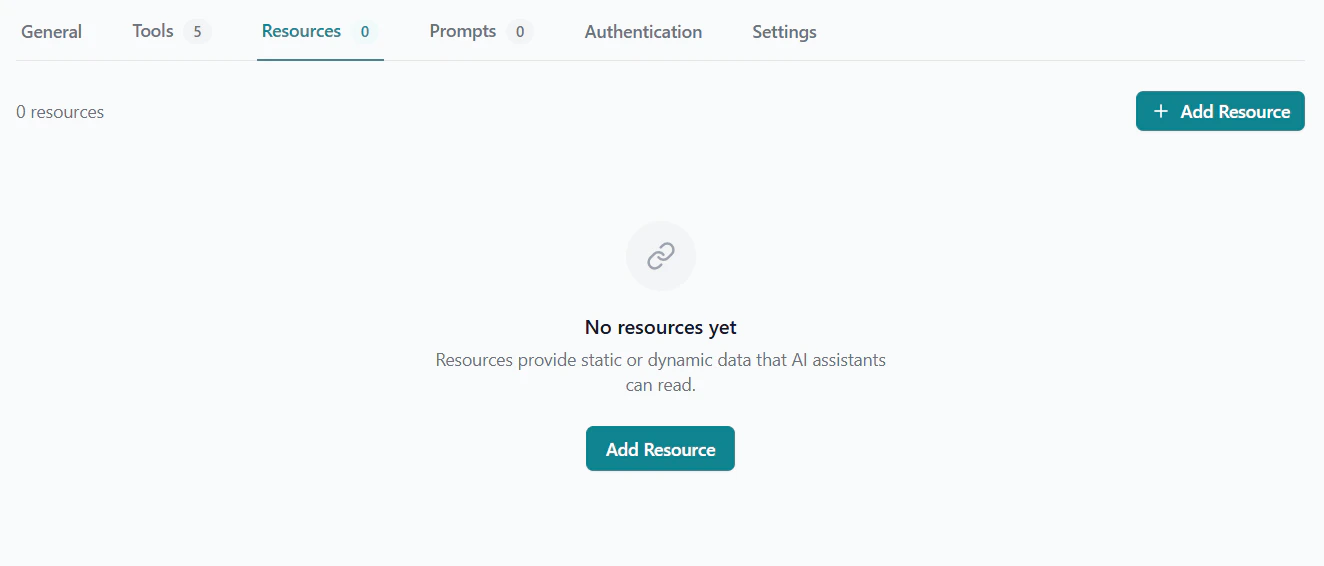
3
Set URI and Name
Enter a URI (e.g.,
docs://api-overview) and a human-readable name.4
Choose Data Source Type
Select the data source type and fill in the corresponding config fields.
5
Set Template URI (optional)
If this is a parameterized resource, add a URI template pattern (e.g.,
docs://posts/{slug}).6
Save
Click Save. The resource is now available via
resources/list (or resources/templates/list if a template URI is set) and resources/read.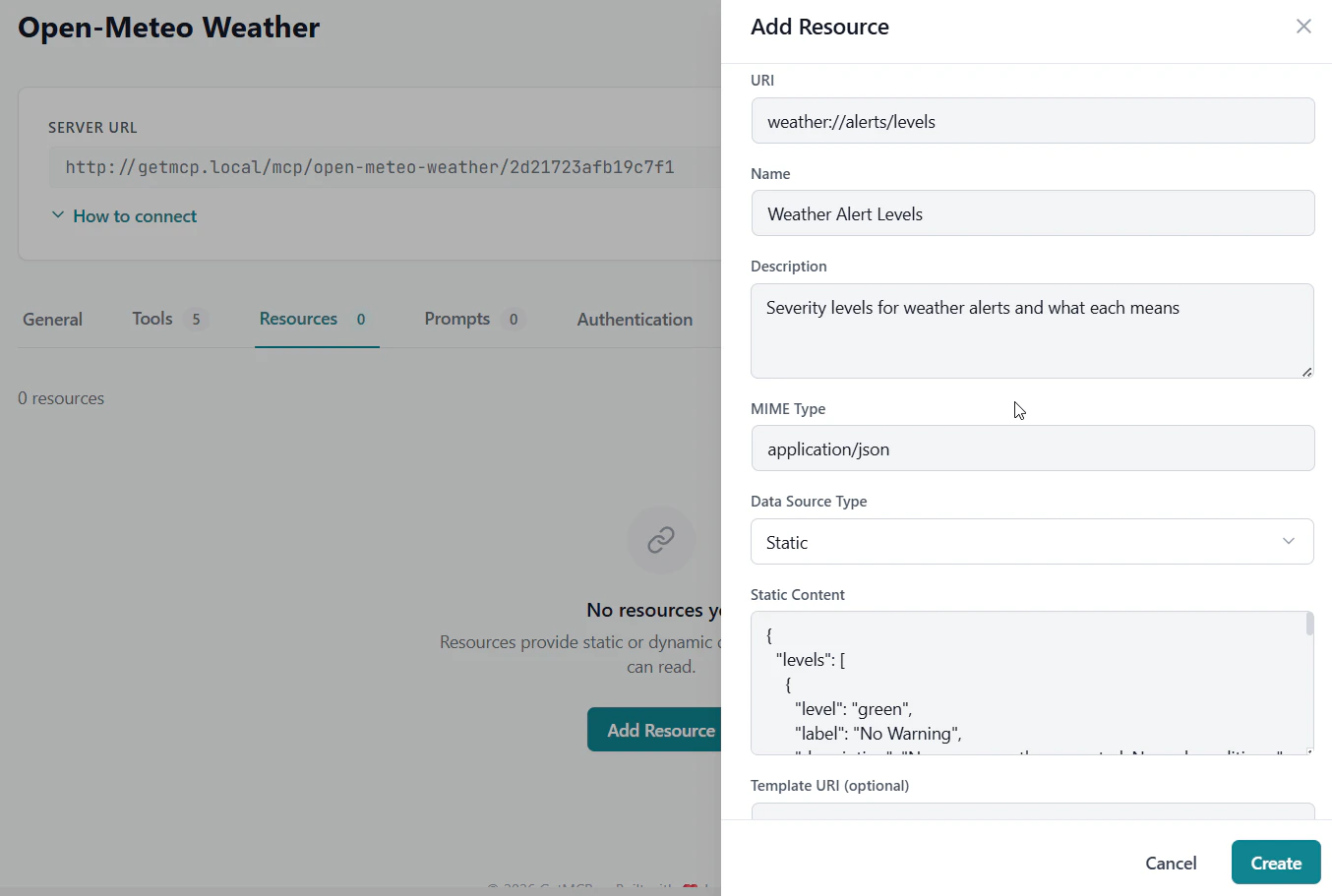
MCP Protocol
Resources integrate with the standard MCP protocol methods:resources/list— Returns all resources that have a fixed URIresources/read— Returns the content of a specific resource by URIresources/templates/list— Returns resources that have atemplate_uriset